Key takeaways
- A trademark protects your brand identity — the name, logo or sign customers use to recognise you.
- Copyright protects original creative work — text, software, artwork, music and film — and arises automatically on creation.
- A patent protects a new, inventive and industrially useful invention, but only if it is granted by the Patent Office.
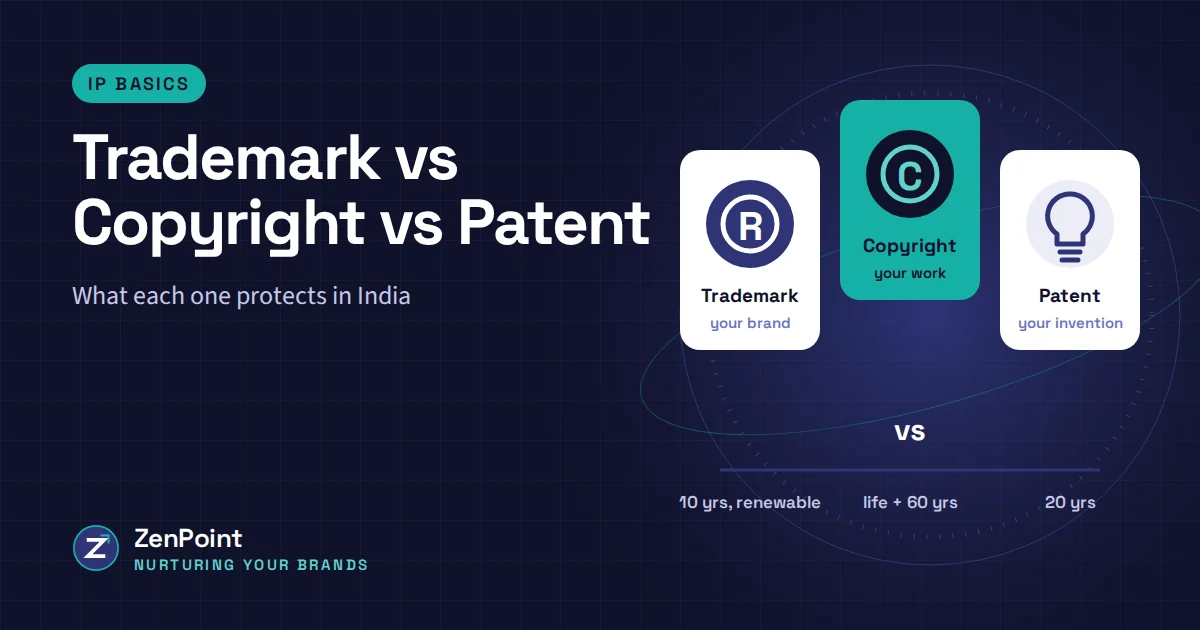
- Trademarks can last indefinitely with renewal; copyright generally lasts for the author’s life plus sixty years; patents last twenty years.
- Many businesses need more than one — a single product can carry all three.
“Should I trademark it, copyright it or patent it?” is one of the most common questions founders ask. The three are often spoken of as if they were interchangeable. They are not. Each protects something different, arises in a different way, lasts for a different period and is enforced differently. Choosing the wrong one can leave the valuable part of your business unprotected.
The short answer
- Protect who you are with a trademark.
- Protect what you create with copyright.
- Protect how something works with a patent.
Trademark — protecting your brand
A trademark is a sign that distinguishes your goods or services from everyone else’s: your brand name, logo, tagline, and in some cases a shape, colour combination or sound. In India it is governed by the Trade Marks Act, 1999.
Rights can arise from use, but registration with the Trade Marks Registry gives you the exclusive right to the mark for the registered goods or services and a straightforward action for infringement. A registration lasts ten years from filing and can be renewed indefinitely. For the basics, read our guide What is a trademark?, or see how we handle trademark registration.
Copyright — protecting creative work
Copyright protects original literary, dramatic, musical and artistic works, cinematograph films and sound recordings. Software is protected as a literary work. In India it is governed by the Copyright Act, 1957.
Copyright arises automatically the moment the work is created — no registration is needed for the right to exist. Registration with the Copyright Office is optional but valuable: an entry in the Register of Copyrights is prima facie evidence of the details recorded in it, which makes disputes and takedowns far easier. For most works, copyright lasts for the author’s lifetime plus sixty years.
Copyright protects the expression of an idea, not the idea itself. Someone may write their own book on the same subject as yours; they may not copy your text. See our copyright registration and enforcement service for details.
Patent — protecting inventions
A patent protects an invention — a product or process that is new, involves an inventive step, and is capable of industrial application. In India patents are governed by the Patents Act, 1970, and some subject matter (such as a mere business method or a computer program as such) is excluded.
Unlike copyright, a patent exists only once it is granted after examination. In exchange for twenty years of exclusive rights from the filing date, the inventor must publicly disclose how the invention works. Timing matters: disclosing the invention publicly before filing can destroy its novelty.
ZenPoint handles trademark and copyright matters only. For a patent, you will need a registered patent agent.
Side by side
| Trademark | Copyright | Patent | |
|---|---|---|---|
| Protects | Brand identity — name, logo, sign | Original creative expression | New, inventive, useful inventions |
| Indian law | Trade Marks Act, 1999 | Copyright Act, 1957 | Patents Act, 1970 |
| How rights arise | Use; far stronger with registration | Automatically on creation | Only when granted |
| Registration | Optional, strongly advised | Optional, useful as evidence | Essential |
| Duration | 10 years, renewable indefinitely | Generally author’s life + 60 years | 20 years from filing |
| Office | Trade Marks Registry | Copyright Office | Patent Office |
One product, three protections
Imagine a company that launches a new coffee machine. Its brand name and logo are protected by trademark. The artwork on its box, its user manual, its website copy and the app that controls the machine are protected by copyright. The new brewing mechanism inside may be protected by a patent. And the distinctive look of the machine itself may be registrable as an industrial design under the Designs Act, 2000.
Each right is enforced separately. A competitor who copies the name infringes the trademark; one who copies the manual infringes copyright; one who copies the mechanism infringes the patent.
Where trademark and copyright overlap: your logo
A logo is both an artistic work and a brand identifier, so it can be protected by copyright and by trademark at the same time. The two do different jobs. Copyright protects the artwork against copying; trademark protects its use as a badge of origin in the marketplace, including against similar — not just identical — marks.
Two practical points follow. First, make sure your business actually owns the copyright in its logo: if a freelance designer created it, you need a written assignment. Second, when registering copyright in an artistic work that is used on goods, the Copyright Office requires a certificate from the Registrar of Trade Marks, so the two registrations are often handled together.
Which one does your business need?
- Launching a brand, shop, app or service? Start with a trademark search and a trademark application for the name.
- Creating content, software, designs, music or courses? Consider copyright registration for your key works.
- Developed a genuinely new technical solution? Speak to a patent agent before you disclose it publicly.
- Selling a physical product with a distinctive look? Consider design registration alongside your trademark.
Frequently asked questions
Can I copyright a brand name?
No. Names, titles and short phrases are generally not protected by copyright. A brand name is protected as a trademark.
Can I patent a business idea?
An idea by itself cannot be patented, and business methods are excluded from patent protection in India. What can often be protected is the brand under which the business trades.
Is software protected by copyright or patent?
Software code is protected by copyright as a literary work. A computer program “as such” is not patentable in India, though an invention involving software may be, if it meets the legal tests.
Which lasts the longest?
A trademark, potentially — it can be renewed every ten years for as long as it is used. Copyright is long but finite, and a patent expires after twenty years.
Do I need all three?
Not necessarily. Most businesses need a trademark; many also benefit from copyright; fewer have a patentable invention. Tell us what you have and we will advise on the trademark and copyright side.
Last reviewed: 21 October 2026 · Prepared by the ZenPoint editorial team · Editorial policy